
Build a B2B Application Library
Explore six sample records, follow the product–application–resource relationships, and download the data to adapt.
- Evidence
- Static data exercise
- Status
- Experimental
- Audience
- builder
Start with a visitor’s job.
A product archive assumes the visitor knows which product family to choose. An application library gives them another entry: the job they need to do. The content model then connects that job with relevant product information, constraints and evidence.
This Lab uses six original teaching records. They describe example information needs, not real products, client data, compatibility findings or engineering instructions.
The model.
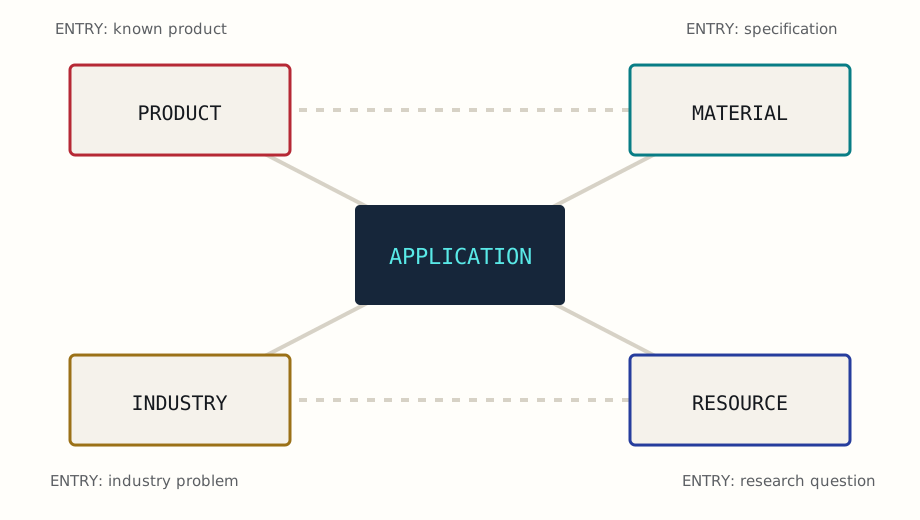
| Field | Purpose | Rule |
|---|---|---|
| id | Stable record identity. | Keep it stable when the title changes. |
| title and question | Explain the visitor’s job. | Write in the visitor’s language. |
| industry and material | Provide useful entry filters. | Use controlled terms consistently. |
| product | Point toward a product category. | A real suitability claim needs evidence. |
| resource | Give the visitor an explanation or next step. | Avoid a link without an answer behind it. |
| evidence | Make the claim boundary visible. | Examples stay identified as examples. |
Explore the sample records.
app-001 · Field service
Identify reusable equipment cases
How will a technician identify the right case after repeated handling?
| Material context | Product category | Supporting resource |
|---|---|---|
| Polymer case | Identification system | Identification requirements worksheet |
app-002 · Maintenance
Organize service-tool storage
How will a technician notice a missing tool before leaving the workshop?
| Material context | Product category | Supporting resource |
|---|---|---|
| Foam insert | Storage system | Tool inventory checklist |
app-003 · Manufacturing
Explain replacement-part selection
Which information distinguishes compatible replacements from similar-looking parts?
| Material context | Product category | Supporting resource |
|---|---|---|
| Mixed materials | Parts catalogue | Part selection field map |
app-004 · Education
Track training equipment
Who has the equipment, what condition is it in and what is due back?
| Material context | Product category | Supporting resource |
|---|---|---|
| Mixed materials | Asset record system | Equipment handoff checklist |
app-005 · Logistics
Document packaging requirements
Which dimensions and handling constraints must travel with a packaging request?
| Material context | Product category | Supporting resource |
|---|---|---|
| Paperboard | Packaging system | Packaging brief |
app-006 · Maintenance
Prepare a maintenance resource hub
Can a technician reach the correct instructions from the equipment record?
| Material context | Product category | Supporting resource |
|---|---|---|
| Mixed materials | Documentation system | Resource review checklist |
What this implementation does.
One structured dataset generates the record cards and the downloadable JSON. The archive filters by the industry term on each record. With “Maintenance” selected, two records match; the other four stay out of the result. Changing a title does not require changing its ID.
In a future WordPress implementation, Application could be a content type, with classification fields or taxonomies chosen for their editorial purpose. Rich product and resource relationships should point to records instead of repeating their full text. The official post-type and taxonomy documentation explains the available primitives.
What a production library adds.
- Real product and resource records with stable links.
- Sources and a responsible reviewer for suitability claims.
- Editorial handling for withdrawn products and stale resources.
- Clear empty states and a route back when a filter finds nothing.
- Migration checks that preserve relationships, not only text.
There are no performance or conversion claims attached to this exercise. Its purpose is to make the information model inspectable.
Adapt this pattern.
For a school, replace product with course and application with learning outcome. For a nonprofit, replace them with service and community need. Keep the stable identifiers, the visitor’s question and the evidence behind the relationship.
Choose three records from your own subject and write the questions first. If the relationships do not help answer those questions, simplify the model before adding more fields.
Sources and further reading
Primary documentation checked September 14, 2026. Product behavior and terms can change; follow the source for current details.
KEEP EXPLORING