
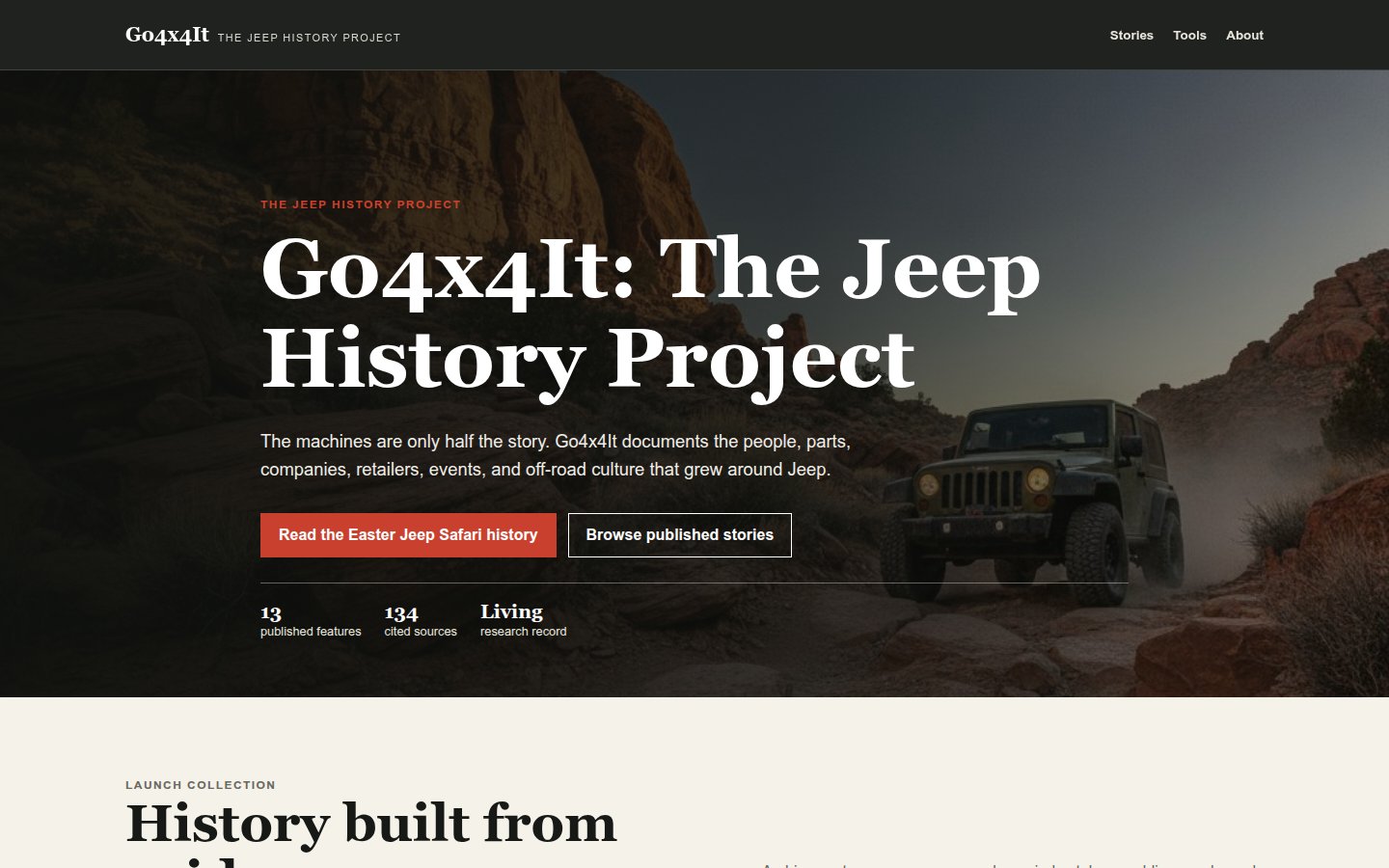
The machines are only half the story. Go4x4It documents the people, parts, companies, events, and culture that grew up around Jeep — and cites its sources while doing it.
A publication with a research pipeline behind it.
Enthusiast history is usually written from memory and repetition, which is how the same wrong dates circulate for decades. This build put an evidence process upstream of the writing.
- Every feature has a dossier — before a story is written, its subject gets a research file: a chronology, a source map, and an explicit note on what each source can and can’t prove. The published piece draws only on that.
- Claims carry their evidence — a company’s own press release is cited as a company account, not as independent proof. Firsthand recollection is attributed to the person who remembers it. The distinction stays visible to the reader.
- A living record, not a pile — it’s built to be corrected and extended as better sources surface, rather than published once and left to rot.
- Written by someone who was there — the Jeep aftermarket isn’t a research topic here — it’s where I spent years of my career, which is what makes the gaps in the public record visible in the first place.
The same bones
You’ll read this list on every build story. That’s deliberate — the architecture is the product.
- One house theme system — a shared parent theme with a light per-site child, so every fix strengthens every site.
- Native, editable blocks — owners maintain their own pages; nothing we ship breaks the editor.
- Forms-only contact — spam-filtered forms, never a printed email address.
- Real metrics only — one lightweight measurement rail; no vanity numbers.
- Search & answer-engine ready — clean structure, structured data, and instant indexing pings on every publish.
- Type that fits every screen — one fluid typography scale across the whole portfolio.
Want your site built this way? Start a conversation.