
Proof · Google Ads · Jan–Jul 2022
Google replaced my hand-written ads with automation. Here’s what it cost.
In 2022, Google retired Expanded Text Ads — the format you write yourself — and moved every advertiser onto automated Responsive Search Ads. On this industrial account I could see both running in the same ad group before the switch. The hand-written ads weren’t slightly ahead. They were beating the automated version on nearly every metric that decides whether ad spend works.
Same ad group · top hand-written ad vs. the automated one
Click-through rate
Avg. cost per click
Top-of-page impressions
■ hand-written (Expanded Text Ad) · ■ automated (Responsive Search Ad)

The full numbers
| Ad (same ad group) | Clicks | Impr. | CTR | Avg. CPC | Cost | Top-of-page |
|---|---|---|---|---|---|---|
| hand-written | 5,313 | 46,198 | 11.50% | $3.91 | $20,799.69 | 87.97% |
| automated | 1,202 | 15,198 | 7.91% | $4.72 | $5,670.25 | 77.33% |
| hand-written | 1,089 | 10,323 | 10.55% | $3.78 | $4,120.22 | 86.82% |
| hand-written | 593 | 7,568 | 7.84% | $4.59 | $2,724.78 | 89.77% |
One older hand-written ad (7.84% CTR) ran about even with the automated one — I’m leaving it in rather than cherry-picking. The two strongest hand-written ads still cleared it by a wide margin.
A second ad group — and why I nearly left it out
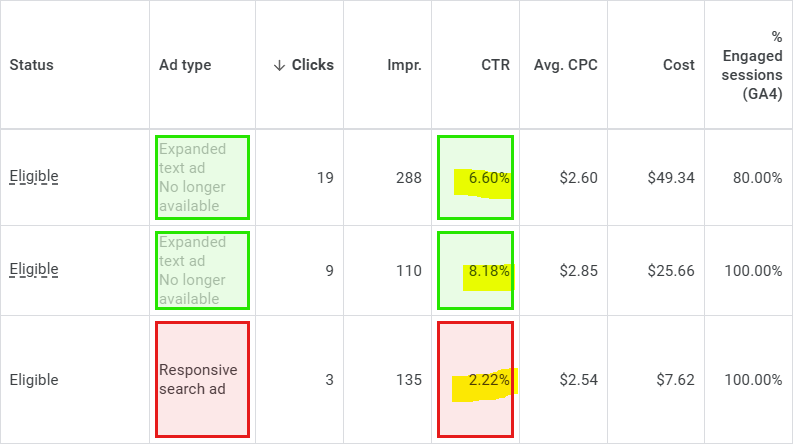
Same account, same seven months, a different ad group. The pattern repeats and the gap is wider — the frozen hand-written ads pulled 6.60% and 8.18% click-through against the automated ad’s 2.22%.
| Ad (second ad group) | Clicks | Impr. | CTR | Avg. CPC | Cost | Engaged (GA4) |
|---|---|---|---|---|---|---|
| hand-written | 19 | 288 | 6.60% | $2.60 | $49.34 | 80.00% |
| hand-written | 9 | 110 | 8.18% | $2.85 | $25.66 | 100.00% |
| automated | 3 | 135 | 2.22% | $2.54 | $7.62 | 100.00% |
Look at the click column before you take this seriously: nineteen, nine, and three. That is far too small to prove anything on its own — if this were the only table on the page, you should throw it out. It is here because it points the same way as the one above, not because it is evidence by itself.
What this actually proves — and what it doesn’t
This is one account, one ad group, one seven-month window — not a controlled study, and I won’t dress it up as one. The automated ad was newer, with less history to learn from, and Responsive Search Ads do get better as you feed them. Say all of that out loud and the result still stands.
The point isn’t “automation is always worse.” It’s narrower and more useful: the whole industry keeps pushing you to hand the entire job to the machine — and when you do that without someone skilled watching the numbers, it quietly costs you. The better ad here was written by a person who knew the product, the buyer, and the exact search term. Google didn’t make that ad worse. It just removed the option to run it and told everyone the automated version was the future.
I use automation every day — for the mechanical parts. I don’t hand it the parts that decide whether you win: the offer, the message, the negative keywords, the bids. That’s the whole difference between ad spend that compounds and ad spend that evaporates.
If your ad spend is on autopilot and you’re not sure it’s working
That’s worth a straight conversation — no pitch, no dashboard theater. I take on a small number of industrial accounts at a time, and I start by reading your numbers the way I read these.